Questions about marble and limestone
Honest answers about material, samples, bespoke work, delivery, care and collaboration. If your question is not listed, please do get in touch.
Material & choice
What makes marble unique?
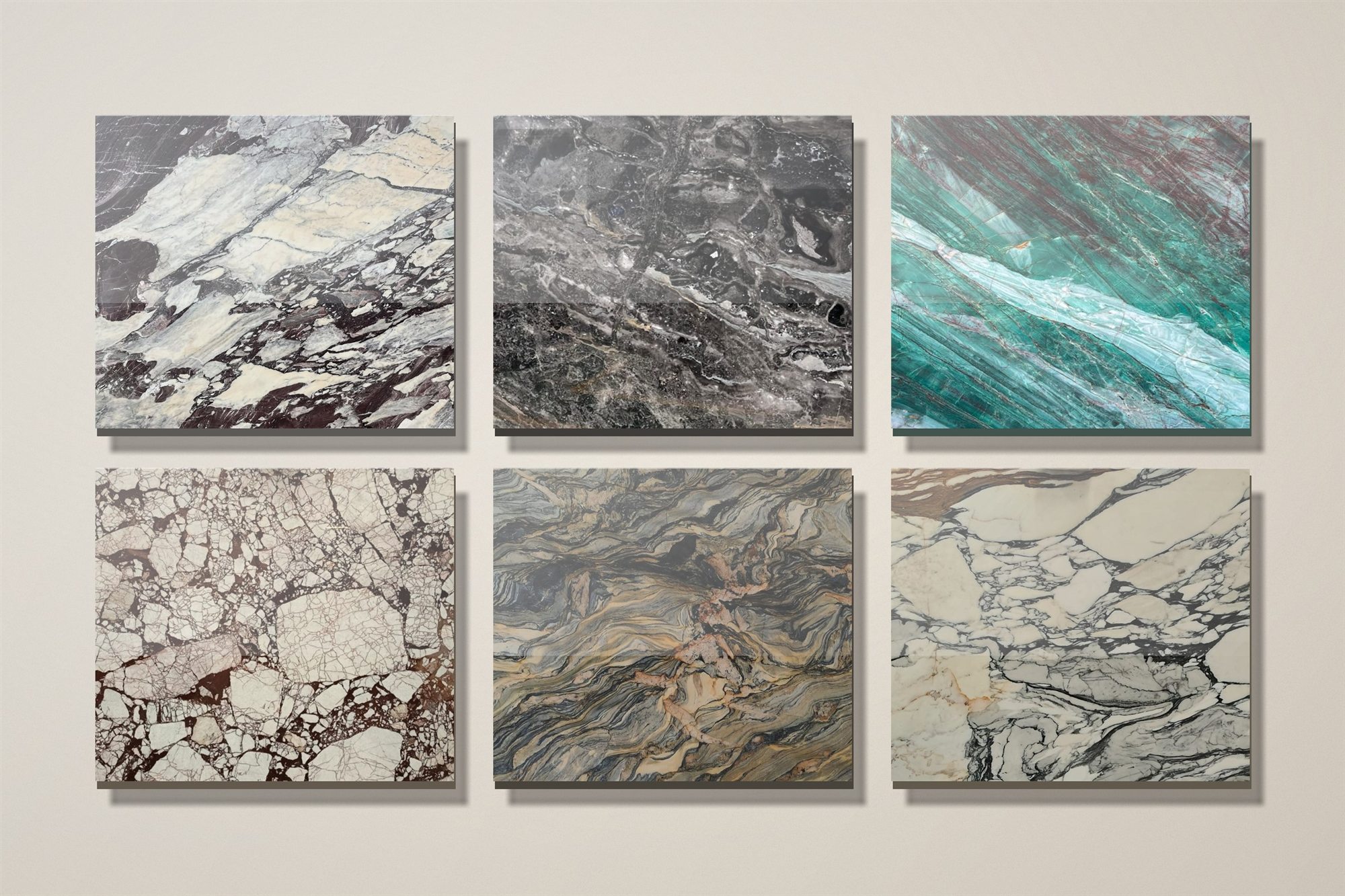
Marble was once limestone. Under high pressure and temperature, deep within the earth's crust, it recrystallised. Minerals trapped in the process form its veins and colours. Because that process never unfolds in exactly the same way, no two slabs are alike. What you choose is always a unique piece of nature, with a pattern that cannot be repeated.
What does it mean that marble is calcareous?
Marble consists largely of calcite or dolomite. These minerals react with acids: lemon juice, vinegar, wine, soft drinks and acidic cleaners leave a dull mark, known as an etch mark. This is not a stain you can polish away, but a slight erosion of the surface. Careful use and the right finish limit how visible it is.
What is patina?
Patina is the soft character natural stone acquires through use over the years: small etch marks, a slightly more matt sheen along walkways, a warmer tone. Many enthusiasts see it as a quality, as with leather or oak. If you prefer to keep a pristine surface, marble can periodically be re-honed and re-polished by a specialist.
Which stone should I choose for indoors, and which for outdoors?
Indoors we work with marble, for floors, walls, bathrooms, kitchens and furniture. Outdoors, for facades, terraces and gardens, we work with Portuguese limestone in a finish suited to its use. If you are unsure about a particular location, such as a covered loggia or a very humid bathroom, we advise case by case.
Are quartzite and onyx also marble?
No, although they sit alongside marble in our collection. Quartzite is a metamorphosed sandstone consisting mainly of quartz: harder and less sensitive to acids. Onyx is a layered, translucent calcareous stone that is beautiful when backlit, but softer and more brittle than marble. Both have their own applications, which we explain project by project.
Samples & selection
How do I request samples?
On the Request samples page, choose the varieties and finishes you would like to see. Briefly indicate what you are considering the stone for, so that we can put together a suitable selection. If you are not yet sure which variety it will be, describe your application and colour preferences, and we will make a proposal.
Why does a sample differ from the slab I receive?
A sample is a small fragment of a variety, often from a different slab or batch than the one used for your project. Colour and pattern may therefore differ, particularly with varieties that have bold veining or a breccia pattern. The sample mainly shows you base tone, structure and finish. You see the precise movement during a slab selection.
Can I view the slabs for my project myself?
Yes. For projects in which the pattern plays a leading role, such as a kitchen island, a bookmatched wall or a table from a single slab, we recommend a slab selection by appointment. You then decide which slabs are used and where the veins fall in your design. Arrange this via the contact page.
How do I best assess a sample?
View the sample where the stone will go, in daylight and under the lighting you use in the evening. Place it beside your floor, cabinet fronts, fabrics and metals. Look at it wet as well, particularly for bathrooms and outdoors: natural stone often deepens in colour when wet. Focus on base tone and structure, not on a single vein.
Bespoke work & furniture
Which furniture do you make in solid marble?
Among other things, we make dining tables, coffee and side tables, cabinets and washbasins in solid marble, made to measure and in the variety of your choice. Exclusive furniture designs are also created in collaboration with design studio Germans Ermičs. We tailor form, dimensions and finish to your space and your design, or to that of your interior architect.
What should I consider with a solid marble table?
Solid marble is heavy. Consider the route into the room in advance: stairs, lifts and doorways. For large tops, we review the base construction and, where necessary, the load-bearing capacity of the floor. Discuss use as well: a dining table will meet wine and citrus, so finish and care deserve attention.
Can you clad a kitchen island or cabinet in marble?
Yes. We clad objects such as kitchen islands and cabinets in marble, with carefully detailed corners and joints, so that the object appears to be made from a single piece of stone. Whether an existing object is suitable depends on its construction and load-bearing capacity. We assess this per project, preferably on the basis of drawings and photographs.
Do you work with my interior architect?
Gladly. We work from the drawings and material plan of your interior architect or design studio, and contribute ideas on choice of stone, slab layout and detailing. If you would rather have guidance on the whole, we also offer complete advice: from stone to furniture, sofas, fabrics and materials, attuned to one coherent interior.
Do you also supply tiles and slabs made to measure?
Yes. Alongside furniture, we supply marble tiles for floors and walls, and slabs: the large panels for tops, walls and cladding. We tailor formats and thicknesses to the application. For projects involving extensive cutting, we prefer to work from a drawing, so that dimensions and veining are right across the entire surface.
Delivery & installation
What is the lead time?
That depends on the variety, the availability of slabs, the amount of bespoke work and the schedule of your project. For that reason we do not quote a standard lead time. We discuss a realistic schedule with the quotation and keep you informed throughout the project. If you have a fixed completion date, please share it with us as early as possible.
Do you also handle installation?
In the Netherlands we fabricate and install marble for private clients and businesses, for example in bathrooms, kitchens, living rooms and offices. Outdoors, we handle delivery and, by arrangement, installation of limestone for facades and terraces. If you work with your own contractor or installer, we supply made to measure and coordinate the details with them.
What needs to be arranged before the stone is delivered?
Make sure the space is accessible and the substrate is ready as agreed: level, dry and load-bearing. Large slabs and solid furniture require a clear route and sometimes lifting equipment. We go through the logistics with you or your contractor in advance, so there are no surprises on the day itself.
How is marble protected during further building work?
On a site where other trades are still at work, it is wise to cover floors and tops with clean, breathable protective material. Do not apply tape directly to polished marble, and keep acidic building products, such as cement residue removers, away from the stone. That way the surface remains intact until handover.
Care
How do I clean marble day to day?
With lukewarm water and a pH-neutral cleaner or a dedicated natural stone soap, and a soft cloth or mop. Dry afterwards, particularly with hard water, to prevent limescale marks. Avoid all-purpose cleaners, vinegar, lemon, bleach and abrasives: they attack the surface or leave a film that dulls the stone.
How often should marble be sealed?
That depends on the variety, the finish and the use, so we do not give a fixed interval. A simple test helps: drip a little water onto the stone. If it beads, the protection is still working. If it soaks in within a short time and the stone darkens, it is time to seal again.
What should I do about a stain?
Acting quickly helps. Blot the stain with kitchen paper without rubbing, then clean with water and a pH-neutral product. If the stain has nevertheless soaked in, as with oil, coffee or wine, a specialist can often achieve a great deal with a stain-removing poultice. Do not try aggressive products yourself: they often make the damage worse.
Can scratches and dull patches be restored?
Yes, in many cases. Marble is a solid material: a specialist can re-hone and refinish the surface locally or in its entirety. Etch marks, scratches and wear paths then disappear. That is a great advantage of natural stone over materials that have only a thin top layer.
How do I care for limestone outdoors?
Sweep away leaves and dirt regularly and clean with water, a soft brush and, if needed, a pH-neutral stone soap. Green growth in shady spots is natural and can be removed with a product suitable for natural stone; test it first in an inconspicuous place. Do not use de-icing salt, and be cautious with a pressure washer.
Dealers & professionals
How do I become a Rockstar Stone dealer?
Apply as a reseller via the dealer page. Tell us briefly about your company, your clients and how you would like to offer natural stone. We will contact you to arrange an introduction. Once your application has been approved, you will receive access to the secure dealer portal.
I am already a dealer. Where do I log in?
Existing dealers log in via the Dealer login page, which gives access to the dealer portal with documentation and technical information on the collection. If your login does not work, or a new colleague needs access, please get in touch and we will help you.
Do you work with interior architects and bathroom specialists?
Yes. Through our trade programme, interior architects, design studios, interior decorators and bathroom specialists can come to us for samples, material advice, slab selection and bespoke work to drawing. We contribute during the design phase and make sure that, in execution, the stone does what you envisaged in the design. You can read more on the page for professionals.
Do you supply marble blocks to artists?
Yes. We have a dedicated department for artists and sculptors, and supply rough marble blocks for sculpture. Tell us which variety, colour and dimensions you are looking for and what you intend to use the block for. We will then see what is available and what suits your work.
More questions about marble?
Is your question not listed? Get in touch or book an appointment for personal advice.